
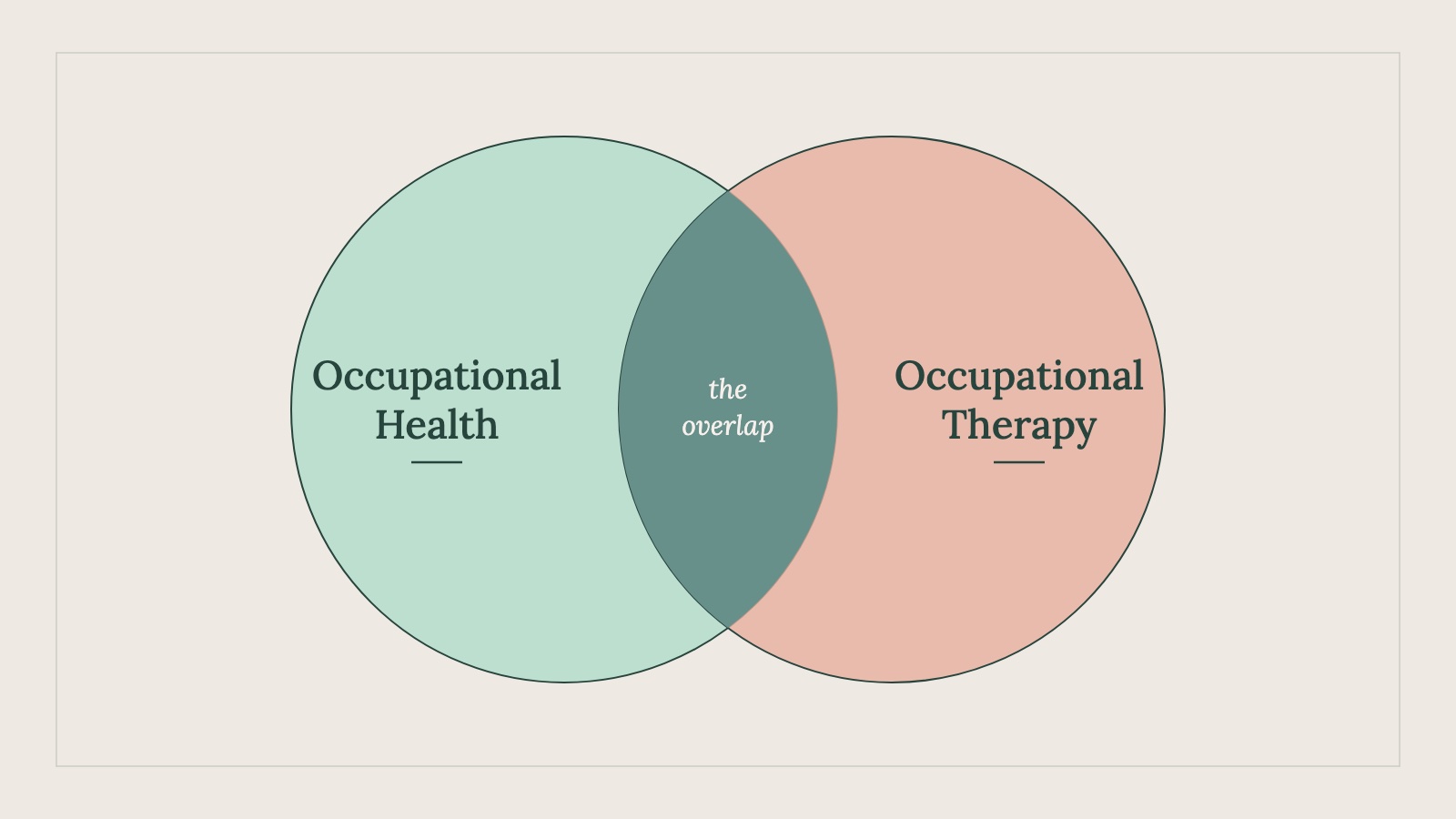
If you’ve ever told someone you’re seeing an occupational therapist and watched them nod knowingly and say “oh, so they’re getting you back to work?”, you’re in very good company. Occupational therapy and occupational health get muddled up all the time, and honestly, we can’t blame anyone. Both have the word “occupation” right at the front, both turn up when work is involved, and to really keep everyone on their toes, some occupational therapists work in occupational health.
So let’s clear it up, in plain English and with as little jargon as we can manage. The short version is that these are two different things with a fair amount of overlap. The longer version is below, and it’s worth a few minutes of your time, particularly if you’re trying to work out who can help you or someone you care about.
One word, two meanings
Most of the confusion comes down to that one word. In everyday language, “occupation” means your job. Ask someone their occupation on a form and they’ll write “teacher” or “accountant”. In occupational therapy, the word means something much bigger. An occupation is anything that occupies your time and matters to you: getting up and getting washed, cooking a meal, doing the food shop, looking after your children, catching a bus, seeing friends, managing your money, studying, volunteering, resting, and yes, working.
This is why people often assume we’re a kind of careers adviser. To be fair, part of what we do does look a bit like that. We can help people think about what kind of work suits them, whether going back to their old role is realistic, or whether it’s time to try something different. But if careers advice were all we did, our training would have been a lot shorter and our job descriptions would fit on a sticky note. Work is one occupation among many, and for lots of the people we see, it isn’t the most pressing one.
What occupational health does
So what is occupational health? It’s a specialist area focused on the relationship between work and health. Its role is to help keep people safe and well at work, and to advise employers on how someone’s health affects what they can do in their job. It’s usually arranged by the employer rather than chosen by the employee, which means the workplace is very much part of the picture.
Occupational health isn’t one profession. It’s a field that several different professionals work in, and you’ll hear them called occupational health practitioners, advisers or clinicians. They might be occupational health doctors (sometimes called occupational physicians), occupational health nurses, physiotherapists or occupational therapists. Occupational health doctors can make medical diagnoses, which is something occupational therapists don’t do.
A typical occupational health involvement might be an assessment after a period of sickness absence, a report to an employer about someone’s fitness for work, health checks for people in certain roles, or advice on adjustments. It’s useful and important work, but it tends to be fairly focused. The central question is usually “can this person do this job, and what needs to change so they can do it safely?” Ongoing treatment generally happens somewhere else, often with your GP or a specialist service.
What mental health occupational therapy does
Mental health occupational therapy, on the other hand, is a therapy. Occupational therapists are registered and regulated by the Health and Care Professions Council (HCPC), and in mental health our focus is helping people get back to living the life they want to lead, across every part of it.
We don’t diagnose, but we do assess, and we assess in detail. We look at what’s happening for someone: how their mental health is affecting their routine, their energy, their concentration, their confidence, their relationships and their ability to do the things they need and want to do. From there, we design and deliver treatment. That might mean rebuilding a daily routine after a long period of illness, working on anxiety that makes it hard to leave the house, developing ways of managing low mood or fatigue, getting back into cooking, budgeting or looking after yourself, reconnecting with hobbies and community, or returning to study or work at a pace that’s sustainable.
The emphasis is on enablement and rehabilitation. That means doing things with people, not to them or for them, and building the skills and confidence that last once therapy ends. Work is often part of that journey, but it sits alongside everything else that makes up a person’s day.
More than the practical
This brings us to another common misconception: that occupational therapists only deal with the practical, functional side of things, like getting dressed, cooking a meal or getting to work. Function is often where we start, but it’s never the whole picture. To help someone change what they’re doing, we first need to understand why it’s so hard for them.
Mental health sits at the very core of occupational therapy training, not as an optional extra. We’re trained to understand the conditions people live with and the psychological drivers behind the behaviours and difficulties that get in the way of daily life. We also understand the main therapeutic approaches used in mental health care, including cognitive behavioural therapy (CBT), acceptance and commitment therapy (ACT), dialectical behaviour therapy (DBT), compassion focused therapy, motivational interviewing, mindfulness-based approaches, and the wider fields of psychology and psychotherapy. Many occupational therapists go on to train further and qualify in one or more of these modalities, which is why you’ll sometimes hear us described as psychotherapeutic occupational therapists or clinical coaches.
Even without that extra training, psychological approaches are woven into everything we do. Over our training and practice we build up thousands of hours of therapeutic conversation and counselling skills, to the point where they become second nature. Our training is trauma informed at its heart and holistic by design, so we look at the whole person: body, mind and spirit, physical and emotional health, behaviour, relationships, environment and what gives someone a sense of meaning and purpose. When someone is struggling to function, we’re taking into account what’s happening for them physically, emotionally and behaviourally, and shaping their treatment around all of it.
Where the two overlap
Here’s where it gets interesting, and where the confusion is completely understandable. Mental health occupational therapists do quite a lot of work that looks very much like occupational health.
Since 2022, occupational therapists in England, Scotland and Wales have been able to issue fit notes, the statements many people still call sick notes. We also write reports giving our clinical opinion on someone’s ability to work, what’s affecting it and what would help. We assess how someone is functioning in relation to their job, and we work with both employers and employees to agree fair, reasonable adjustments so that a person can stay in work or return to it successfully. A phased return, changes to hours or duties, a quieter place to work or a different way of managing workload are all things we regularly help to put in place.
So if you’ve come to us through your workplace, or your employer has asked us for a report, nobody has sent you to the wrong door. It’s work we’re trained and qualified to do.
The real difference
The real difference is in what surrounds that work. Occupational health is a field, and its focus is health in the context of a job. Mental health occupational therapy is a therapy, delivered by HCPC-registered and regulated occupational therapists, and its focus is the whole person. When we write a fit note or help negotiate adjustments, it’s usually one part of a wider piece of assessment and treatment, not the whole story. And when work isn’t the priority at all, we’re still exactly the right people to help.
An easy way to remember it: occupational health asks “are you fit for work?” Mental health occupational therapy asks “what do you need to get your life back, and how can we help you get there?” Sometimes the answer includes work, sometimes it doesn’t, and quite often it’s a bit of both.
If you’re still not sure which kind of support is right for you, or for someone you’re supporting, get in touch with us at Purpose People. An initial consultation is the best place to start, and we’ll help you work out the right next step, even if that turns out to be with someone else.